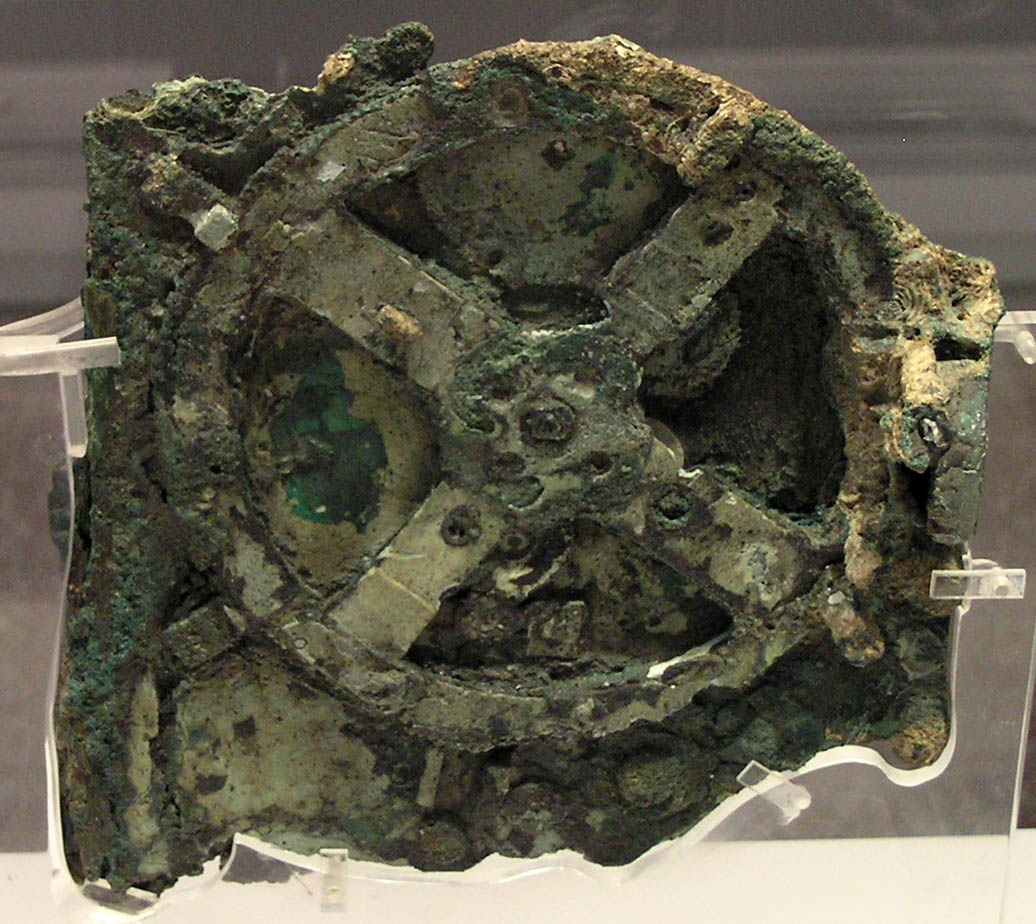
The Antikythera mechanism (/ˌæntᵻkᵻˈθɪərə/ ant-i-ki-theer-ə or /ˌæntᵻˈkɪθərə/ ant-i-kith-ə-rə) is an ancient analogue computer[1][2][3][4] and orrery used to predict astronomical positions and eclipses for calendrical and astrological purposes,[5][6][7] as well as the Olympiads, the cycles of the ancient Olympic Games.[8][9]
Found housed in a 340 millimetres (13 in) × 180 millimetres (7.1 in) × 90 millimetres (3.5 in) wooden box, the device is a complex clockwork mechanism composed of at least 30 meshing bronze gears. Its remains were found as one lump, later separated in three main fragments, which are now divided into 82 separate fragments after conservation works. Four of these fragments contain gears, while inscriptions are found on many others.[10][11] The largest gear (clearly visible in Fragment A at right) is approximately 140 millimetres (5.5 in) in diameter and originally had 223 teeth.
The artefact was recovered probably in July 1901[12] from the Antikythera shipwreck off the Greek island of Antikythera.[13] Believed to have been designed and constructed by Greek scientists, the instrument has been dated either between 150 and 100 BC,[5] or, according to a more recent view, in 205 BC.[14][15]
After the knowledge of this technology was lost at some point in antiquity, technological artefacts approaching its complexity and workmanship did not appear again until the development of mechanical astronomical clocks in Europe in the fourteenth century.[16]
All known fragments of the Antikythera mechanism are kept at the National Archaeological Museum, in Athens, along with a number of artistic reconstructions of how the mechanism may have looked.[17]